
Business technology resource
Where Should This Information Live? Connecting Industry Software, Microsoft 365, and the System of Record
Choose an authoritative system for each business record, then design working copies, collaboration, integrations, exceptions, retention, and ownership around that decision.
Short answer
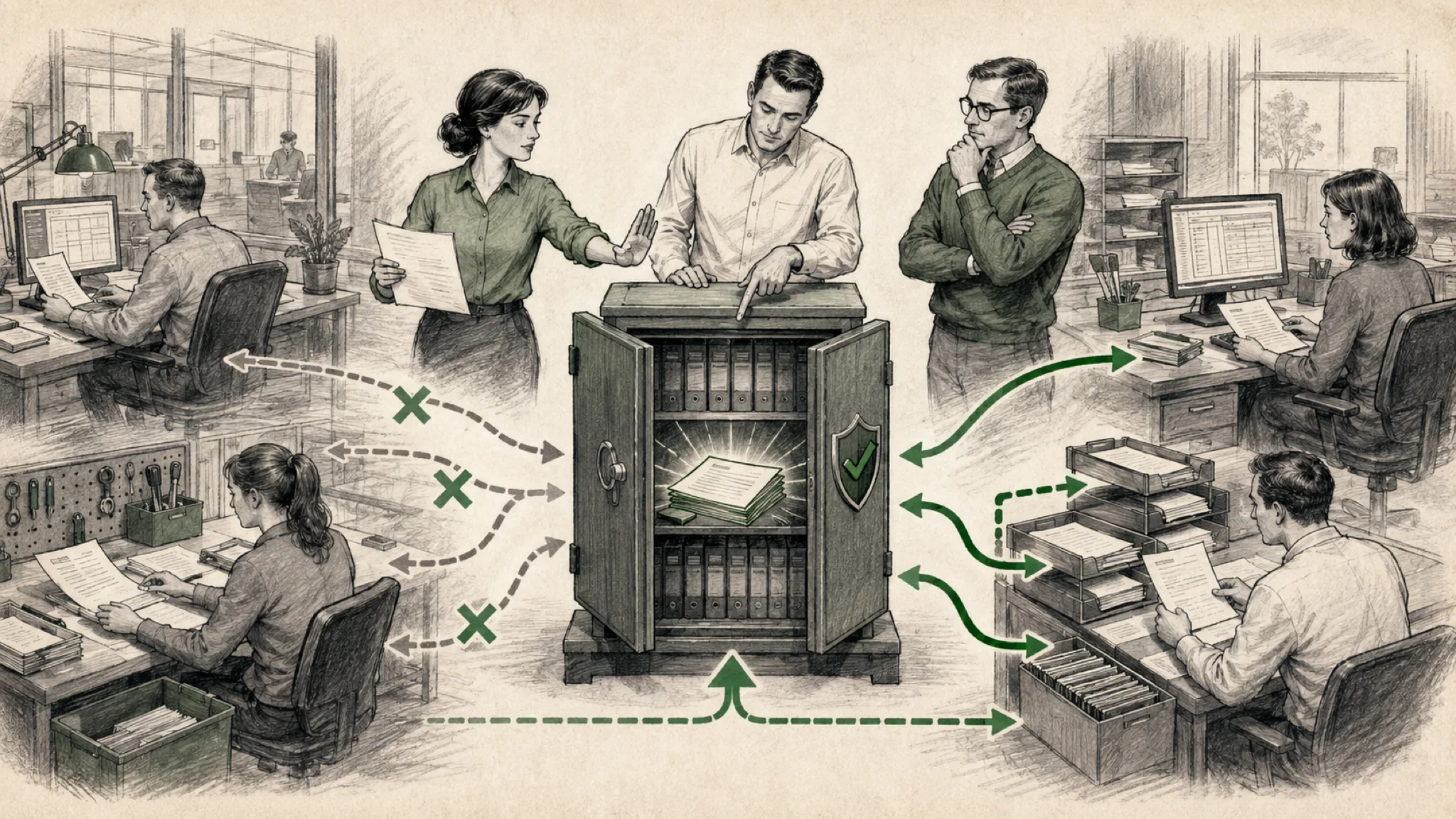
Information should live in the system accountable for its business meaning, lifecycle, access, integrity, and downstream use. A specialized industry platform may own matters, patients, jobs, projects, donors, inventory, students, vehicles, or properties. Microsoft 365 may be the appropriate home for collaboration, documents, communication, approvals, and controlled working information. An accounting system may remain authoritative for financial transactions and balances.
The decision is record-specific, not platform-wide. Integration may copy or summarize information for a valid purpose, but every copy needs an owner, freshness rule, error path, protection level, retention decision, and reconciliation method. Avoid turning Teams, SharePoint, spreadsheets, email, or a reporting database into an accidental second system of record.
Frame the decision around the operating condition
Start with the work the organization must perform, the information it depends on, and the consequence when a handoff fails. Document the current condition before prescribing a replacement, integration, automation, control, or subscription.
Leadership needs evidence of reliable use, controlled access, accountable ownership, recoverable information, supportable change, and a path for exceptions. Use these decision factors:
- The business record being created, the decision it supports, and the person accountable for its meaning.
- The authoritative system, approved working location, necessary copies, and prohibited storage locations.
- Who may create, change, approve, correct, export, retain, archive, or delete the information.
- The event that starts and ends the record lifecycle and the rules for closed, inactive, or historical records.
- Integration direction, timing, identifiers, validation, duplicates, exceptions, monitoring, and reconciliation.
- Search, reporting, discovery, privacy, continuity, portability, contract, and provider dependencies.
Make responsibilities explicit
Industry platforms depend on business owners, employees, vendors, Microsoft 365, devices, networks, identity, integrations, and recovery services. Product contracts do not necessarily assign every operating responsibility.
Before making changes, name who approves the outcome, performs the work, and sustains it. Shared participation is normal; accountability still needs a named owner.
| Role | Primary responsibility | Evidence to retain |
|---|---|---|
| Business owner | Define the record, purpose, authoritative result, approvals, and acceptable exceptions | Record definition, workflow, decisions, and acceptance criteria |
| System owner | Govern configuration, access, lifecycle, data quality, exports, and vendor relationship | Configuration, permissions, data dictionary, and service record |
| Integration owner | Operate interfaces, identifiers, validation, monitoring, retries, and reconciliation | Interface map, logs, alerts, error queue, and test evidence |
| Information owner | Set classification, collaboration, retention, archival, search, and disposal requirements | Information standard, workspace design, review, and disposition record |
Recognize warning signs before they become urgent
Treat these signals as questions to investigate, not proof that a product or provider failed. Preserve examples, dates, affected workflows, and business consequences so the decision rests on evidence.
- Employees cannot agree which system contains the current or approved version of important information.
- A spreadsheet or email attachment silently overrides the industry platform without a governed exception.
- The same customer, matter, job, item, property, or vendor has inconsistent identifiers across systems.
- Integrations create duplicates or failures that no person, queue, alert, or reconciliation process owns.
- Reports combine data without documenting definitions, timing, exclusions, transformations, and source systems.
- A vendor controls exports, credentials, configuration, or institutional knowledge needed for transition or recovery.
What to verify before buying or changing technology
Verify requirements, current capability, ownership, and transition consequences before selecting a tool. Ask vendors to distinguish included features, licensed modules, supported integrations, services, and customer responsibilities.
Test representative workflows and exceptions. Record the evidence, open assumptions, acceptance owner, and post-launch measures. Leadership should answer these questions:
- What business record is being governed, and which decision or obligation depends on it?
- Which system is authoritative, and what makes that system appropriate for this record?
- Which working copies or summaries are justified, and how are they protected, refreshed, and retired?
- What unique identifier connects the record across systems without ambiguous matching?
- How are failed, delayed, duplicate, incomplete, or conflicting updates detected and resolved?
- Can the organization export, interpret, retain, recover, and transition the information when needed?
Use a bounded improvement sequence
Evidence may support retaining the current system, improving configuration, clarifying ownership, connecting a handoff, adding a recovery control, or replacing only a justified gap. Sequence the smallest useful change.
Define success before implementation and schedule a review. Show what changed, what remains unresolved, who operates the result, and when the decision returns to leadership.
| Stage | Practical action | Decision produced |
|---|---|---|
| Define | Name the record, owner, meaning, lifecycle, authoritative system, and required consumers | Approve the information boundary |
| Map | Trace creation, collaboration, interfaces, copies, reports, exceptions, retention, and recovery | Expose duplication and ownership gaps |
| Improve | Clarify workspaces, configuration, identifiers, integrations, validation, and reconciliation | Authorize the smallest useful change |
| Govern | Measure quality, exceptions, usage, access, lifecycle, vendor changes, and business outcomes | Retain, revise, or retire the design |
Related next steps
Related articles
Continue exploring this topic
Sources and further reading
- Microsoft Learn — SharePoint Information Architecture
- NIST — Cybersecurity Framework 2.0
- Carolina Technology Pros — Application and Integration Assessment
This resource provides general business-technology guidance. Engagement scope, evidence, and recommendations depend on the organization’s actual condition.