
Business technology resource
Clio Docket: From Court Alert to Attorney Action
A docket alert can accelerate awareness, but it does not calculate every deadline, exercise legal judgment, authorize a filing, or prove that the required action occurred.
An alert begins a workflow; it does not complete one
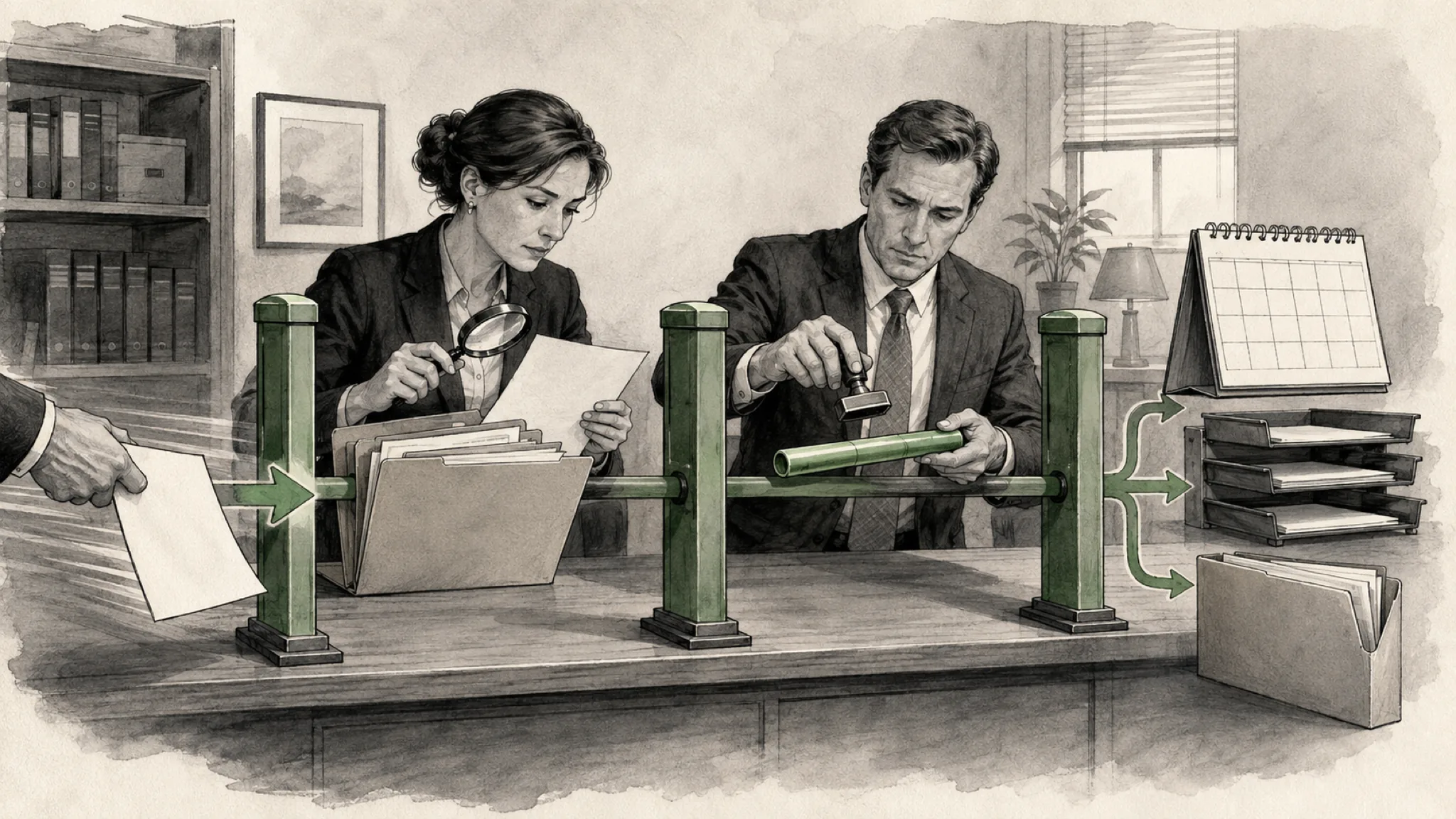
A new filing may need to be matched to the correct matter, opened and authenticated, evaluated for deadlines and legal significance, assigned, calendared, discussed with the client, researched, drafted against, filed, and later verified. Receiving an alert completes only the awareness step. The risk moves rather than disappears if no one owns what follows.
Clio currently presents Docket within Clio Work as a way for eligible users to monitor supported courts, search federal and state filings, retrieve court documents, and continue into research, analysis, strategy, and drafting. Those capabilities may shorten parts of the work, but the firm must separately define authoritative sources, attorney review, calendar controls, filing authority, and proof of completion.
Verify coverage for the firm’s actual courts and matters
Do not convert a broad coverage statement into an assumption about a particular court. Clio publishes separate federal and state coverage directories, and the state directory marks some courts or counties as full coverage and others as partial. Availability can change, and the meaning of partial coverage must be understood for the firm’s matter types and required documents.
Build a matter inventory by jurisdiction, court, case type, docket identifier, and monitoring need. Compare it with current vendor coverage immediately before implementation and renewal. Record exclusions and special handling. If a court, document type, sealed filing, agency, or legacy matter is not dependably covered, keep an explicit alternate monitoring method rather than allowing it to become an undocumented exception.
Map every checkpoint from court event to action
Use several representative matters to trace the complete chain. Name the person responsible at each checkpoint and the evidence that proves the handoff worked. The attorney who evaluates legal significance may be different from the person who reviews alerts or enters dates, but responsibility cannot be left between roles.
| Checkpoint | Required decision | Evidence |
|---|---|---|
| Monitoring and matter match | Is this the correct case, party, court, and matter? | Verified identifiers and documented match review |
| Alert and document review | Is the alert complete, authentic, available, and significant? | Source document, timestamp, reviewer, and disposition |
| Deadline and assignment | What dates and actions require attorney approval? | Approved calendar entry, task owner, escalation, and second check |
| Analysis and response | What research, strategy, drafting, client communication, or filing is required? | Attorney-approved work product and source trail |
| Completion | Did the required action actually occur? | Filed receipt, sent communication, completed task, or other controlling proof |
Design for false matches, missing alerts, and unavailable documents
Test similar party names, reused case numbers, transferred matters, amended captions, duplicate alerts, delayed alerts, permission failures, and documents that cannot be retrieved. Determine how staff recognize an ambiguous match and prevent an incorrect alert from contaminating a client matter. A false positive consumes time; a false negative may never announce itself.
Create escalation rules for urgent events, unresolved matches, unavailable source documents, conflicting dates, absent reviewers, and system outages. Define who may dismiss an alert and what reason must be recorded. Maintain backup monitoring appropriate to the matter until the firm has enough evidence to change it, and periodically compare the vendor feed with an independent baseline.
Keep deadlines and legal judgment under accountable control
A filing date or alert is not necessarily the trigger date for every applicable deadline. Rules, service method, court orders, local practice, holidays, extensions, and the procedural posture can change the calculation. The firm should decide which calendar system is authoritative, who calculates and approves dates, whether a second check is required, and how later changes propagate.
The same boundary applies to Clio Work research and drafting. Generated or retrieved material can support attorney work, but it should not be treated as controlling authority merely because it appears beside the matter. Require source validation, citation checking, privilege and confidentiality controls, and attorney approval proportionate to the consequence of the output.
Pilot against a baseline with stop conditions
Select a bounded set of active and historical matters across the courts the firm actually uses. Establish the existing monitoring baseline, then compare match accuracy, alert timeliness, document availability, duplicate volume, reviewer effort, escalations, calendar accuracy, and completion evidence. Include expected failures and periods when the primary reviewer is unavailable.
Write stop conditions before the pilot: missed material events, unresolved false matches, permission leakage, unreliable source access, excessive duplicate volume, or workflow failures that staff cannot detect and recover from. Document the fallback procedure and the person authorized to invoke it. Expansion should follow repeatable evidence, not familiarity with the interface.
Choose an operating boundary, not a blanket reliance decision
The result may approve Docket for certain supported courts with defined review controls, retain existing monitoring for exclusions, integrate alerts into another calendar or task system, or defer adoption. Recheck coverage, entitlements, workflow performance, and staffing at renewal and whenever the firm enters a new jurisdiction or materially changes practice areas.
Related next steps
Related articles
Continue exploring this topic
Sources and further reading
- Clio: Clio Docket availability announcement
- Clio: Clio Docket federal court coverage
- Clio: Clio Docket state court coverage
- Clio: Clio Work product and pricing overview
This resource provides general business-technology guidance. Engagement scope, evidence, and recommendations depend on the organization’s actual condition.