
69%
reported individual use
In 8am’s 2026 survey research, reported use of general-purpose generative AI among legal professionals more than doubled from the prior year.
AI Adoption and Readiness Assessment for Law Firms
In development - pilot not open
This assessment is in development, with a limited paid pilot planned but not open. The proposed work starts with valuable opportunities and readiness, including information boundaries, source checks and attorney accountability, then informs platform requirements.
The first conversation is a practical fit discussion—not a commitment to purchase software, prohibit AI, begin implementation, or change providers.
Questions this assessment answers
Leadership readiness checklist
If one or more answers are unclear, the firm has a visibility or governance gap—not simply a need for another AI product.
Can leadership identify which AI tools, accounts, and embedded features attorneys and staff currently use?
Can the firm explain what client, matter, personnel, firm, or public information enters each environment?
Has the firm defined approved accounts and configurations—and when a use is prohibited, controlled, or routine with baseline safeguards?
Can reviewers demonstrate authoritative-source checks, citation and quotation verification, and actual professional judgment?
Is there an accountable owner for policy, training, exceptions, incidents, pilot measures, and periodic review?
Who this is for
The assessment is designed for managing partners, firm owners, and practice leaders who need a dependable operating view—not another generalized AI presentation.
Illustrative sample
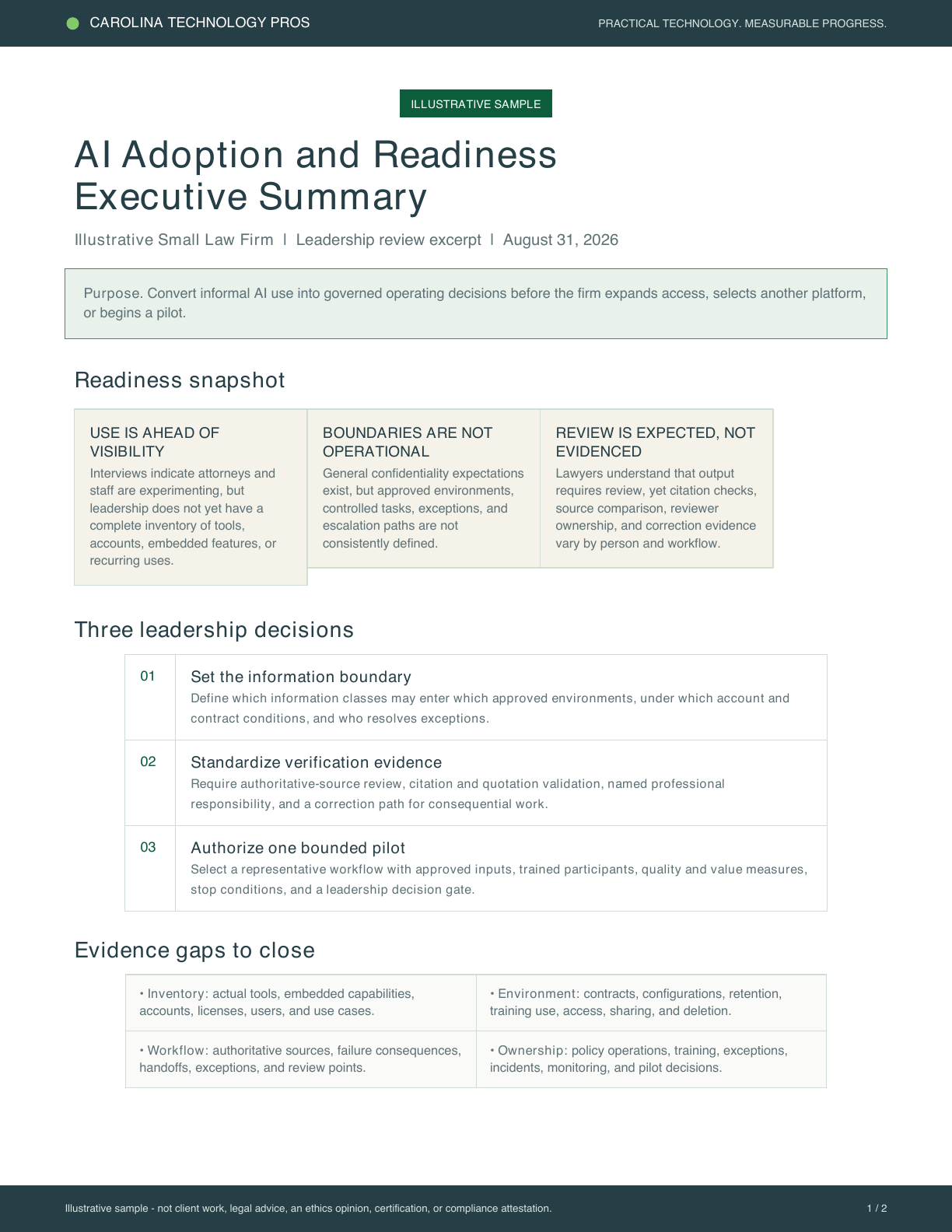
This fictional two-page excerpt shows how assessment evidence can be organized into a leadership brief and a bounded 90-day roadmap.
The full engagement adds validated evidence, firm-specific use and vendor inventories, workflow qualification, an authority-review register, and findings reviewed with leadership.
View the sample executive summary (PDF, 2 pages)Illustrative sample only—not client work, legal advice, an ethics opinion, certification, or compliance attestation.
Adoption evidence
The opportunity is no longer simply to experiment. Leadership needs a coordination layer that connects technology, information, governance, training, verification, and measurable workflow value.
69%
In 8am’s 2026 survey research, reported use of general-purpose generative AI among legal professionals more than doubled from the prior year.
54%
Access without practical training leaves people to make inconsistent decisions about information, verification, and appropriate use.
43% / 9%
Forty-three percent reported no planned formal AI policy, while only nine percent reported a policy that was actively enforced.
These findings come from vendor-sponsored 8am research and describe its surveyed respondents, not every lawyer or law firm. Read the 8am 2026 legal-industry report.
What uncertainty can cost
The cost is not limited to a bad answer. Informal use can alter workflows, information handling, review habits, accountability, licensing, and client expectations without leadership seeing the change.
People may already use AI for research, summaries, drafts, analysis, or administration while the firm lacks an inventory, boundaries, or a dependable way to learn from actual use.
Risk depends on the information, task, account configuration, contract, retention and training terms, access controls, and where data is processed—not simply the product name.
Fluent output can hide fabricated authority, inaccurate quotations, misstated holdings, omitted context, or unsupported conclusions that survive a superficial review.
Vendor selection, IT ownership, or a lawyer being somewhere in the workflow does not show who verified the work or exercised judgment.
Standalone tools can duplicate capabilities already present in approved practice, research, productivity, or document platforms.
Claims of saved time or reduced effort are difficult to defend without a baseline, representative work, quality measures, exception handling, and explicit stop conditions. A pilot should show whether AI reduces total effort, preserves quality, and redirects attorney or support-staff time to higher-value work.
A policy is one control, not the operating system. The assessment connects approved use, technology configuration, authoritative sources, training, review, ownership, monitoring, and pilot evidence.
South Carolina context · Last reviewed August 31, 2026
The legal landscape is moving quickly. The assessment records current sources and turns them into technology and workflow questions while the firm’s counsel determines legal and ethical applicability.
The March 25, 2025 interim policy applies directly to South Carolina Judicial Branch employees and volunteers. It requires approved tools, human oversight, independent verification, and restrictions around confidential or privileged information.
The interim policy does not directly bind private practitioners, but it reminds lawyers appearing before South Carolina courts to exercise caution, verify accuracy, and preserve confidentiality under existing professional obligations.
South Carolina Rule of Professional Conduct 1.1 includes the duty to keep abreast of changes in law and practice, including the benefits and risks associated with relevant technology.
As of this review, no statewide South Carolina state-court rule requiring attorneys to disclose AI use in filings was identified. Matter-specific, judge-specific, federal, and later-issued requirements still require counsel’s review.
Carolina Technology Pros provides technology-governance and workflow guidance—not legal advice, an ethics opinion, filing certification, or compliance attestation. Counsel determines which duties, rules, orders, and client commitments apply.
Risk and accountability
General-purpose and legal-specific tools can both be useful, and neither category removes the firm’s responsibility to qualify the environment, verify the work, and respond appropriately when something goes wrong.
AI can invent cases, create quotations that do not exist, misstate a real holding, omit controlling context, or produce a confident conclusion unsupported by the cited source.
Client, matter, personnel, financial, or firm information may be exposed when the task, account type, contract, configuration, access, retention, or vendor handling has not been approved.
A human-in-the-loop statement is weak if the firm cannot show the authoritative sources checked, the reviewer’s responsibility, the exceptions resolved, and the final decision made.
A mistake can become more consequential when people conceal tool use, provide inaccurate explanations, fail to correct the record promptly, or cannot reconstruct what happened.
Selected enforcement examples
The court imposed a $5,000 penalty after attorneys submitted nonexistent decisions and then stood by false material through inadequate and misleading follow-up. The opinion addressed both the filing and the response after doubts were raised.
Review the Mata sanctions discussion in U.S. Courts materials.The court imposed a $2,500 sanction after a brief contained 16 fabricated quotations. It expressly noted that greater candor about the role of generative AI likely would have produced a lesser sanction.
Read the Fifth Circuit opinion (PDF).In a matter involving fabricated quotations and broader litigation conduct, the court imposed $15,000 on each attorney, fees and double costs, and referrals. The result should not be reduced to a single tool error.
Read the Sixth Circuit opinion (PDF).The court publicly admonished counsel after briefing cited nonexistent cases that appeared potentially AI-generated, emphasizing that existing duties of competence, candor, and verification already address the conduct.
Read the Fourth Circuit opinion (PDF).The examples involve different facts, conduct, procedures, and remedies. They do not establish that every error was exclusively caused by AI or that every matter leads to the same sanction.
Proposed operational framework
The assessment classifies uses by task, data, audience, consequence, account configuration, authoritative sources, and required professional judgment—not by product brand alone.
This is the assessment’s proposed operational framework. It is informed by guidance emphasizing competence, security, supervision, confidentiality, and independent professional judgment; it is not attributed to or presented as a North Carolina State Bar tiering system. Read North Carolina 2024 Formal Ethics Opinion 1.
Dated reference notes
These links support the dated context on this page. They are reference points, not a substitute for counsel’s review of current, court-specific, client-specific, carrier-specific, or matter-specific requirements.
Last reviewed August 31, 2026
Addresses lawyers’ use of generative AI under duties including competence, confidentiality, communication, candor, supervision, and reasonable fees.
The reported error rates describe the tested product versions and query sets from the 2024 study—not current 2026 product performance.
Tracks decisions addressing established or suspected hallucinated material; the collection is broader than attorney-sanction decisions and its count changes frequently.
A current index for counsel to check as South Carolina guidance develops.
When to take a closer look
What we examine
Who is using what, for which tasks, with which information, under what account, and with what known workarounds, adoption patterns, or avoided uses.
Existing platform capabilities, overlapping licenses, account configurations, contracts, data handling, supportability, and qualification criteria for additional vendors.
Client and matter confidentiality, privilege-sensitive workflows, data classification, access, retention, training use, sharing, deletion, and incident escalation.
The actual task, source of truth, inputs, outputs, handoffs, exceptions, audiences, and consequences when an answer is incomplete or wrong.
Citation and quotation checks, source comparison, review evidence, decision ownership, candor, correction, and the point at which professional judgment must be exercised.
Approved-use decisions, policy operations, role-based training, enforcement, monitoring, incident response, pilot baselines, quality measures, value, and stop conditions.
Assessment fit
AI governance and workflow modernization overlap, but they answer different leadership questions.
Use this assessment to govern firm-wide AI use, information handling, verification, ownership, platform decisions, and bounded pilots.
Continue reviewing AI readinessUse this assessment to redesign one high-friction workflow before automating it or selecting implementation technology.
Review process modernizationProposed assessment outputs
These are proposed outputs, subject to method validation and pilot scope. No assessment package or pilot place is currently available to book.
A practical record of known formal and informal uses, tools, accounts, information classes, users, owners, and material gaps.
Candidate workflows prioritized by value, readiness, risk, professional judgment, supportability, and measurement potential.
Decision criteria for configuration, contract, information handling, security, integration, support, exit, and accountable ownership.
Clear permitted, controlled, and prohibited uses tied to information, audience, environment, review, and escalation requirements.
Authoritative-source checks, citation and quotation validation, reviewer responsibilities, exception handling, correction, and evidence expectations.
Role-based learning, acknowledgments, reinforcement, exception handling, monitoring, response, and accountable ownership.
Representative work, controlled inputs, approved users, baselines, quality and value measures, review steps, stop conditions, and decision gate.
A maintained list of relevant ethics opinions, court rules, standing orders, client commitments, insurer conditions, and sources assigned for legal review.
A sequenced path for governance, configuration, training, pilots, measurement, platform decisions, ownership, and periodic review.
A responsible outcome may be to approve, control, prohibit, pilot, optimize an existing capability, defer a purchase, or stop a use. The workflow evidence and the firm’s legal review determine the path.
How the assessment works
The engagement is defined before paid work begins so participants, evidence, confidentiality boundaries, legal-review responsibilities, decisions, timing, and deliverables are understood.
Define the leadership decision, practices and workflows in scope, participants, boundaries, legal-review needs, evidence, deliverables, timing, and investment.
Interview leaders and representative users; inventory tools, accounts, licenses, configurations, policies, training, workflows, sources, incidents, and available measures.
Qualify use cases, information environments, vendors, verification controls, ownership, training, enforcement, measures, and a bounded pilot.
Review the inventory, risk decisions, evidence gaps, roadmap, authority-review register, pilot gate, and the choices leadership and counsel still need to make.
Planned limited paid pilot
The pilot is planned but not open. Development, human rehearsal, method validation, commercial terms and release approval remain outstanding. The principles below describe the intended paid assessment model after those gates are complete.
The first conversation is a brief no-cost fit and scope discussion. Evidence collection, analysis, scoring, findings, and roadmapping begin only after a written scope and fixed fee are approved.
The completed assessment organizes the material findings, risks, responsibilities, decisions, and sequenced roadmap so leadership can act with an internal team, Carolina Technology Pros, an existing provider, or another qualified provider. Implementation is optional, priced separately, and the assessment fee is not an implementation deposit or automatic credit.
Clear boundaries
Carolina Technology Pros organizes technology, information, vendor, workflow, governance, and measurement decisions. The firm and its counsel retain responsibility for professional obligations and legal conclusions.
How Carolina Technology Pros approaches the work
The assessment begins with the work, information, authoritative sources, people, current platforms, and leadership decisions—not a predetermined software sale.
Go deeper
Use these practical resources to prepare questions, compare options, and decide what evidence should come next.
Compare ChatGPT, Claude, Copilot, and Gemini by business fit, governance, cost, and adoption before choosing a platform and planning a controlled pilot.
Read resourceLearn how governed industry, business, competitive, and client context can turn general AI capability into accountable support for one bounded workflow.
Read resourceEvaluate use cases, information sensitivity, human review, governance, and proof-of-value before broad AI adoption.
Read resourceSeparate AI drafting from controlling law, maintained legal guidance, firm precedents, matter records, and accountable attorney verification clearly.
Read resourceCompare legal AI choices through authoritative content, governance, integration, support, portability, and verified reviewer effort before selection.
Read resourceBuild a law-firm AI operating boundary around confidentiality, verification, supervision, client communication, fees, approved tools, and accountable review.
Read resourceQuestions business leaders ask
No. Carolina Technology Pros provides technology-governance and workflow guidance. The assessment is not legal advice, an ethics opinion, filing certification, or compliance attestation. Your firm’s counsel determines applicability of rules, duties, orders, contracts, and client commitments.
No. Some uses may be prohibited, some may require strict controls, and others may be routine with baseline safeguards. The decision follows the task, information, audience, consequence, configuration, authoritative sources, and required judgment.
That is not a product-name question and this assessment does not make the legal determination. The firm must consider confidentiality and privilege obligations alongside the specific account, contract, retention and training terms, access, security, processing, task, and approved review. Counsel should decide the firm-specific rule.
It can produce vendor qualification criteria and a fit recommendation when evidence supports one. Existing approved platform capabilities are examined first, and no named platform is assumed to be uniformly safe, unsafe, approved, or endorsed.
It produces the evidence, approved-use matrix, ownership model, verification protocol, training and enforcement plan, and authority-review register needed to support a workable policy. Firm-specific legal language should be finalized by counsel.
Yes. Current providers can contribute inventories, configurations, contracts, security and support evidence, and operating context. The roadmap can be used by the firm, its existing providers, Carolina Technology Pros, or another qualified team.
No. The assessment defines decisions, controls, ownership, measures, and a roadmap. Configuration, software procurement, pilot execution, training delivery, monitoring, and ongoing services are separately authorized and scoped.
After the fit conversation, a written scope confirms the firm areas, participants, evidence, legal-review responsibilities, deliverables, exclusions, timing, and investment before paid work begins.
A practical first conversation
Share the workflow, policy gap, platform question, client concern, or pilot decision leadership needs to resolve. The first conversation will determine fit—without committing the firm to a purchase or rollout.
If you want implementation help
Your internal team, current provider, Carolina Technology Pros, or another qualified partner can implement the work. Any delivery engagement is optional and scoped separately.